The Difference Between Empathy and Emotional Overload: Why Helping Professionals Need Healthy Boundaries
Jul 10, 2026
Caring Deeply Does Not Mean Carrying Everything
Empathy is often described as one of the most important qualities a helping professional can possess. Therapists rely on empathy to build trust with clients. Nurses use empathy to comfort patients during vulnerable moments. Teachers use empathy to understand the unique challenges their students face. Social workers, coaches, physicians, first responders, clergy, and caregivers all depend on empathy to create meaningful connections with the people they serve.
Because empathy is such an essential part of helping, many professionals begin believing that the more they feel, the better they are at their work. They measure their effectiveness by how much they care, how available they are, and how much of themselves they give to others. While these qualities often come from a genuine desire to make a difference, they can slowly become blurred with something very different: emotional overload.
Many helping professionals do not notice when this shift happens. They simply wake up one day feeling emotionally exhausted, mentally drained, and physically depleted. They still love their work, but it feels heavier than it once did. They find themselves thinking about clients long after the workday ends. They struggle to separate work from home life. They begin carrying emotional burdens that were never meant to be theirs.
The problem is not empathy itself.
The problem is confusing empathy with emotional responsibility.
Understanding the difference can protect not only your well-being but also your ability to continue helping others in a healthy and sustainable way.

What Empathy Really Means
Empathy is the ability to understand another person’s emotional experience while recognizing that it belongs to them. It allows us to connect without becoming consumed. Rather than trying to fix every problem or remove every difficult emotion, empathy invites us to sit alongside someone in their experience with compassion and respect.
Imagine sitting beside a friend who is grieving the loss of a loved one. An empathetic response is not pretending you know exactly how they feel or trying to eliminate their pain. Instead, it is acknowledging their experience, listening without judgment, and offering support while recognizing that their grief is their own journey.
This distinction is important because empathy does not require us to absorb another person’s emotions. It requires us to understand them.
Helping professionals often provide the greatest support not because they carry someone else’s pain, but because they create a safe environment where people can process their own emotions. The therapist does not become the client’s anxiety. The nurse does not become the patient’s fear. The teacher does not become the student’s frustration. Instead, they offer guidance, compassion, and professional support while maintaining a healthy awareness of where another person’s experience ends and their own begins.

When Empathy Turns Into Emotional Overload
Emotional overload often develops gradually, making it difficult to recognize until it has already affected your well-being.
It usually begins with good intentions. You care deeply about the people you serve. You think about how they are doing after sessions. You worry about whether they are safe. You replay difficult conversations in your mind. You feel responsible for outcomes that are beyond your control.
At first, these thoughts may seem harmless. They can even feel like evidence that you are dedicated to your work.
Over time, however, emotional boundaries begin to fade.
Instead of leaving work at work, you bring it home. Instead of feeling compassion, you begin carrying emotional weight that does not belong to you. Your mind continues solving problems long after your workday has ended. Rest becomes difficult because your brain remains occupied with everyone else’s needs.
Eventually, emotional overload affects more than your work. It begins influencing your relationships, your sleep, your mood, and your physical health. You may become emotionally numb, irritable, withdrawn, or constantly exhausted without fully understanding why.
This is not because you care too much.
It is because you have been carrying too much.

Why Helping Professionals Are Especially Vulnerable
Most people do not choose helping professions because they want recognition or financial rewards. They choose them because they genuinely care about improving the lives of others. That compassion is one of their greatest strengths.
Ironically, it can also become one of their greatest vulnerabilities.
Many helping professionals are naturally empathetic people outside of work as well. Friends turn to them for advice. Family members depend on them for emotional support. They become the person everyone calls during difficult times. While these relationships are meaningful, they also mean that caregiving rarely ends when the workday does.
Add demanding caseloads, administrative responsibilities, documentation, staffing shortages, and the emotional demands of the profession itself, and it becomes easy to understand why so many helpers experience burnout and compassion fatigue.
Without intentional boundaries, helping professionals may begin believing they are responsible for every person’s healing. When clients struggle, they question whether they did enough. When progress feels slow, they blame themselves. When someone experiences a setback, they carry disappointment that was never theirs to own.
No one can sustain that level of emotional responsibility indefinitely.

Healthy Boundaries Make You More Effective, Not Less Compassionate
One of the biggest misconceptions about boundaries is that they make people seem distant or uncaring. In reality, healthy boundaries strengthen empathy because they prevent emotional exhaustion from taking over.
Think about a physician performing surgery. They care deeply about their patient, but they also remain focused, regulated, and professional throughout the procedure. If they became overwhelmed by emotion in the middle of surgery, their ability to provide effective care would decrease.
The same principle applies across helping professions.
Healthy boundaries allow professionals to remain fully present without becoming emotionally flooded. They create enough emotional space to think clearly, make sound decisions, and offer genuine support.
Boundaries are not walls that keep people out.
They are guidelines that protect your ability to continue showing up with compassion over the long term.

Signs You May Be Carrying More Than You Realize
Sometimes emotional overload develops so gradually that it feels normal. This is why self-awareness is essential.
You may be experiencing emotional overload if you regularly think about clients long after work ends, feel guilty taking time off, struggle to relax because you are thinking about other people’s problems, feel personally responsible for outcomes beyond your control, or notice that you have become emotionally exhausted even though you still love your work.
You may also find yourself withdrawing from family and friends because you have little emotional energy left to give. Activities that once brought joy begin feeling like additional responsibilities. You become physically tired even after sleeping because emotional fatigue has accumulated over weeks, months, or years.
These signs do not mean you are failing as a professional.
They are signals that your emotional resources need attention.

Learning to Care Without Carrying
One of the healthiest mindset shifts helping professionals can make is recognizing that support and responsibility are not the same thing.
You are responsible for showing up with professionalism, compassion, knowledge, and ethical care.
You are not responsible for controlling another person’s healing journey.
Clients make their own decisions.
Patients face circumstances outside your control.
Students continue learning long after they leave your classroom.
Families make choices based on factors you may never fully see.
Your role is to walk alongside people, not carry them.
This perspective does not reduce compassion.
Instead, it allows compassion to remain sustainable.

Protecting Your Well-Being Is Part of Ethical Practice
Self-care is often presented as something extra, something to fit into your schedule if you happen to have time.
The reality is that caring for yourself is part of being an effective helping professional.
Regular supervision, consultation, peer support, personal therapy, reflective journaling, movement, meaningful relationships, hobbies, and adequate rest are not luxuries. They are protective factors that reduce the risk of burnout, compassion fatigue, and vicarious trauma.
Just as you encourage clients to prioritize their well-being, you deserve the same level of care.
When you consistently invest in your own emotional health, you are better equipped to remain present, thoughtful, and compassionate for the people who depend on you.

Compassion Can Be Sustainable
Helping others is meaningful work, but it should never require losing yourself in the process.
Empathy is one of your greatest strengths, but it becomes most effective when paired with healthy emotional boundaries. You do not have to absorb another person’s pain to support them. You do not have to sacrifice your own well-being to prove your dedication. You do not have to carry every story long after your workday has ended.
The goal is not to care less.
The goal is to care wisely.
If you have noticed yourself feeling emotionally overloaded, constantly exhausted, or struggling to separate your professional role from your personal life, it may be time to invest in your own well-being with the same intention you give to others.
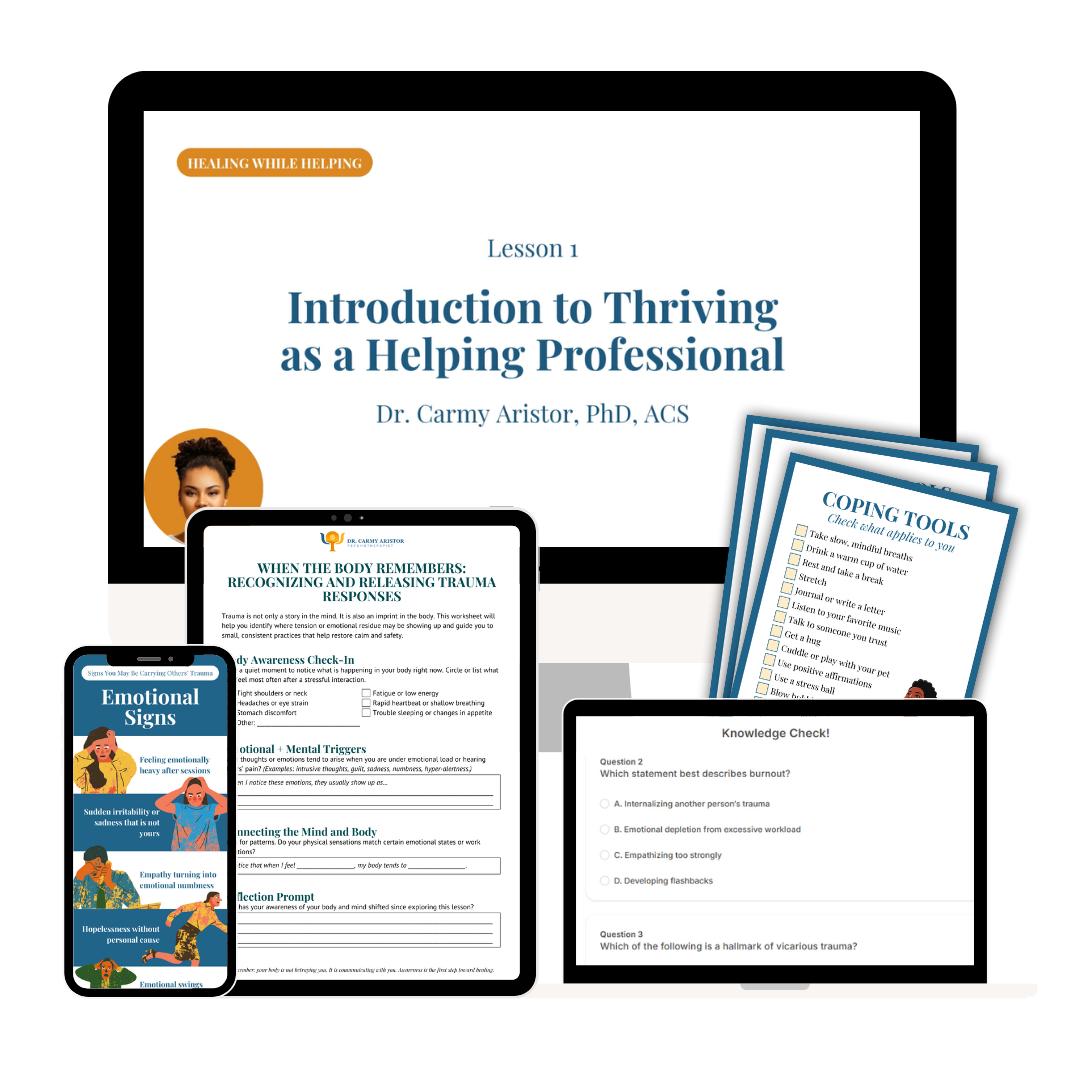
That is exactly why Healing While Helping was created.
Designed specifically for therapists, counselors, social workers, nurses, educators, coaches, caregivers, and other helping professionals, this self-paced course provides practical strategies for understanding burnout, compassion fatigue, vicarious trauma, emotional boundaries, and sustainable self-care.
Because the people who spend their lives helping others deserve support too.
Explore Healing While Helping and discover how you can continue making a difference without losing yourself along the way.