
5 Signs You Have Been Holding Everyone Else Together for Too Long
Jul 03, 2026
If you are a therapist, nurse, teacher, social worker, coach, caregiver, or someone who naturally takes care of others, chances are you have become very good at noticing when someone else is struggling. You can hear the exhaustion in someone’s voice, recognize when a friend is overwhelmed, or sense when a colleague needs encouragement. Supporting others has become second nature.
But when was the last time you asked yourself the same questions?
Helping professionals often spend so much time responding to the needs of others that they overlook their own. They become accustomed to carrying emotional weight, solving problems, and showing up with compassion, even on days when they are running on empty. Over time, this pattern becomes normal. They tell themselves they are simply busy, committed, or resilient, without realizing that they have slowly placed their own well-being at the bottom of the priority list.
The truth is, caring for others is meaningful work, but it should never require sacrificing yourself in the process. If you constantly feel emotionally drained, disconnected from your own needs, or guilty for slowing down, these may be signs that you have been holding everyone else together for far too long.

You Check on Everyone Else Before You Check on Yourself
Think about how you start your day. Do you immediately respond to emails, check on family members, answer client messages, or make sure everyone else is okay before taking a moment to ask yourself how you are feeling? For many helping professionals, this has become such a natural routine that they no longer notice it.
Being caring and compassionate is a beautiful quality, but when your own needs are consistently pushed aside, the imbalance eventually catches up with you. You may become so focused on helping everyone else that you lose touch with your own emotions. You know exactly what others need, yet struggle to answer a simple question like, “How are you really doing?”
Self-awareness is one of the most important parts of emotional wellness. Just as you check your phone battery before leaving the house, your emotional energy deserves regular attention too. Taking a few moments each day to notice your stress level, acknowledge your emotions, and ask yourself what you need is not selfish. It is an essential part of remaining emotionally healthy.

Rest Makes You Feel Guilty Instead of Restored
Many people look forward to a day off because they imagine finally having a chance to recharge. Yet for some helping professionals, rest creates anxiety rather than relief. They sit down to relax only to feel guilty about everything they are not accomplishing. They spend vacations checking work emails. Even during quiet moments, their minds remain focused on responsibilities waiting for them.
This often happens because productivity has become closely connected to self-worth. When your value feels tied to how much you do for others, slowing down can feel uncomfortable. Rest begins to feel like something you have to earn rather than something your body naturally needs.
The irony is that avoiding rest rarely makes you more effective. Instead, chronic exhaustion reduces patience, creativity, focus, and emotional resilience. The very qualities that make you good at helping others become harder to access when you never allow yourself to recover.
Healthy rest is not about doing nothing. It is about giving your mind and body an opportunity to replenish. Whether that means taking a walk, reading a book, spending time with loved ones, or simply enjoying a quiet evening without guilt, rest allows you to continue showing up in a sustainable way.

“I’m Fine” Has Become Your Default Response
How often do you answer the question “How are you?” with “I’m fine,” even when you know you are not?
Many helping professionals become so accustomed to being the listener that they forget how to be honest about their own struggles. They worry about burdening others, appearing unprofessional, or seeming incapable. Instead of expressing what they are feeling, they continue carrying everything alone.
Over time, this habit creates emotional isolation. You may be surrounded by people every day, yet still feel deeply alone because very few people know what you are actually experiencing.
Vulnerability does not mean sharing every detail of your life with everyone you meet. It means allowing trusted people to see the real version of you. Just as your clients, patients, or loved ones benefit from feeling heard, you deserve relationships where you can be honest without feeling like you have to hold everything together.
Sometimes the strongest thing you can say is, “I have been having a hard time lately.”

You Have Forgotten What Brings You Joy
One question many therapists ask clients is, “What do you enjoy doing when you are not working?”
Surprisingly, this question can be difficult for helping professionals to answer themselves.
When life becomes consumed by responsibilities, personal interests slowly disappear. The hobbies you once loved collect dust. Creative activities are postponed. Exercise becomes inconsistent. Time with friends becomes less frequent. Eventually, you begin feeling as though your identity revolves entirely around taking care of other people.
The problem is that work, even meaningful work, should never become your entire identity.
Your life deserves to include activities that exist simply because they bring you joy. Joy is not a luxury. It is an important part of emotional resilience. Activities that make you laugh, create, explore, or simply feel present help replenish the emotional energy that caregiving naturally requires.
Rediscovering those interests may feel unfamiliar at first, but reconnecting with the parts of yourself that exist outside your professional role is one of the healthiest investments you can make.

You Keep Saying You’ll Slow Down “After...”
One of the most common promises people make to themselves is, “Things will calm down after this week.”
After this project.
After this client.
After the holidays.
After the kids are older.
After work becomes less busy.
The problem is that another responsibility almost always takes its place.
Life rarely creates perfect opportunities for rest. If we continue waiting for the schedule to magically become lighter, we may spend years postponing our own well-being.
Healthy boundaries are not created when life becomes easier. They are created intentionally, even during busy seasons.
Sometimes that means protecting one evening each week for yourself. Sometimes it means saying no to responsibilities that exceed your capacity. Sometimes it means recognizing that you cannot pour into others indefinitely without refilling your own cup.
Waiting until burnout forces you to slow down is far more painful than choosing to slow down before you reach that point.

Caring for Yourself Helps You Care for Others
There is a common misconception that self-care is selfish, especially among helping professionals. In reality, caring for yourself allows you to continue caring for others with greater compassion, presence, and resilience.
Imagine asking your phone to function for days without charging it. Eventually the battery dies, no matter how advanced the device may be. Human beings are no different. We all need opportunities to recharge emotionally, mentally, and physically.
Supporting others is meaningful work, but you were never meant to carry every burden by yourself. You deserve the same compassion, patience, and understanding that you so freely offer to everyone else.

You Deserve the Same Care You Give Others
If these signs feel familiar, consider them an invitation to pause rather than a reason for guilt. Awareness is the first step toward change. Recognizing that you have been carrying too much does not mean you have failed. It means your mind and body are asking for the care they have been giving away for so long.
At some point, every helper needs a place where they can stop being the one with all the answers. A place where they can reflect, learn healthier boundaries, understand burnout and compassion fatigue, and reconnect with themselves.
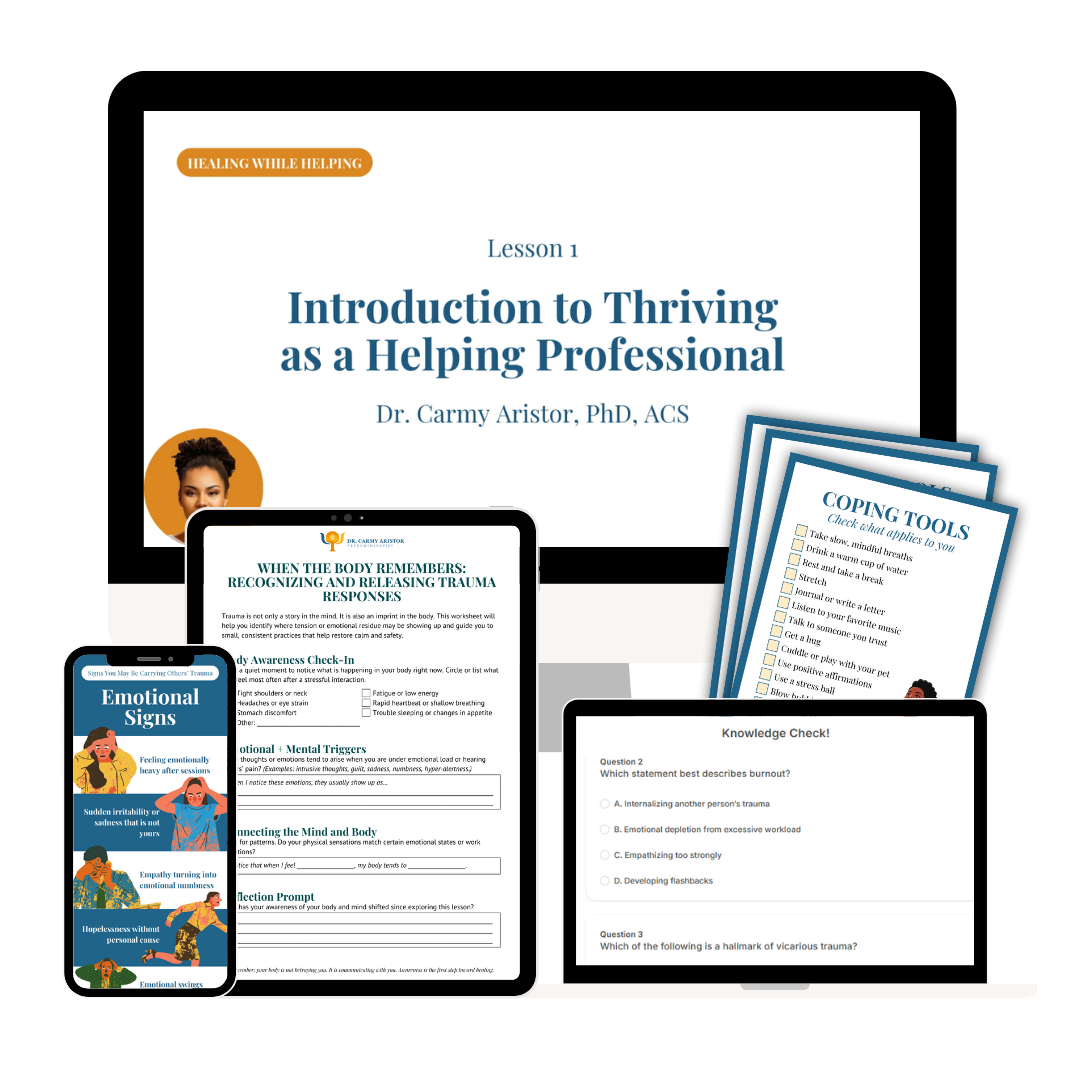
That is why I created Healing While Helping.
Designed specifically for helping professionals, this course explores burnout, compassion fatigue, vicarious trauma, emotional boundaries, and practical self-care strategies that can be integrated into everyday life. You do not have to wait until you are completely exhausted before prioritizing your own well-being.
Because the people who spend their lives helping others deserve support too
.